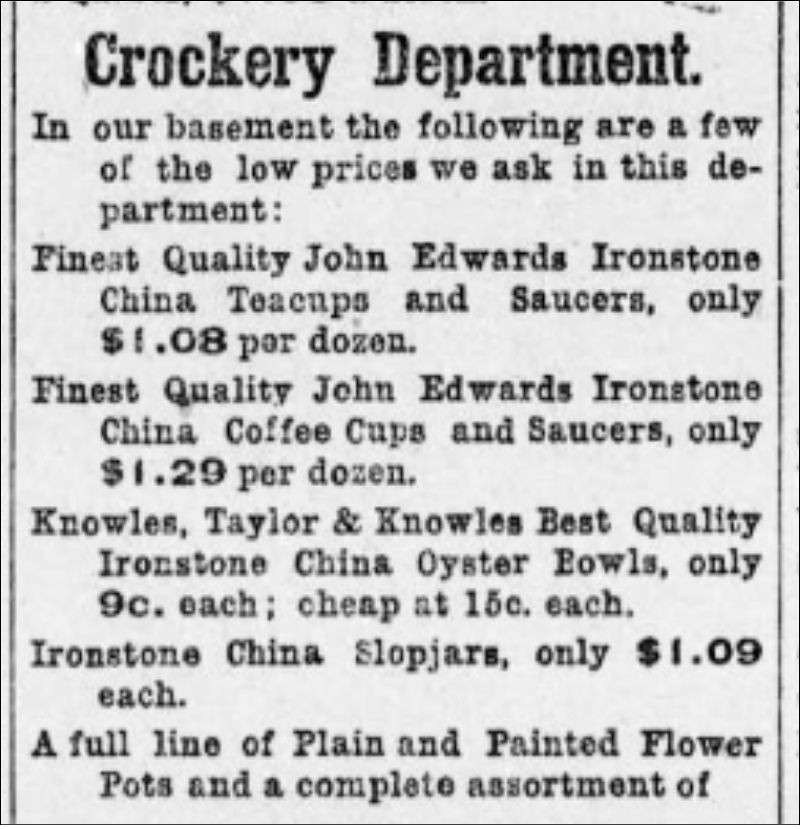


GPL Unearths Antique Bottles from Late 1800s
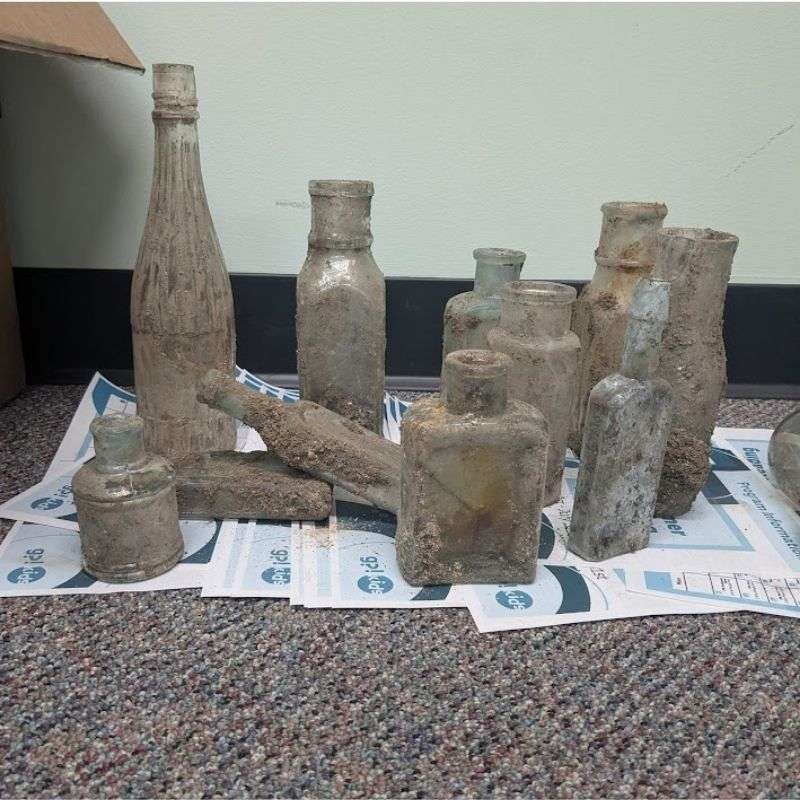
When contractors started digging near the north entrance of the Goshen Public Library as part of their HVAC renovation project, they found something they didn’t expect: a trove of antique glass bottles, dishes, and other objects. Some of the pieces were broken, but many of them were in good enough shape that the workers set them aside for further inspection.
A few GPL staff decided to sort through the items and look for unique markings that could help with research and identification. Here’s what we found!
If you would like to see these objects in person, they are currently on display at the bottom of the stairs in a glass case near the Audiovisual Department.
Interested in where we found some of this information? Check out our online resource, NewspaperArchive.
Click here for access in the library. Click here for remote access.
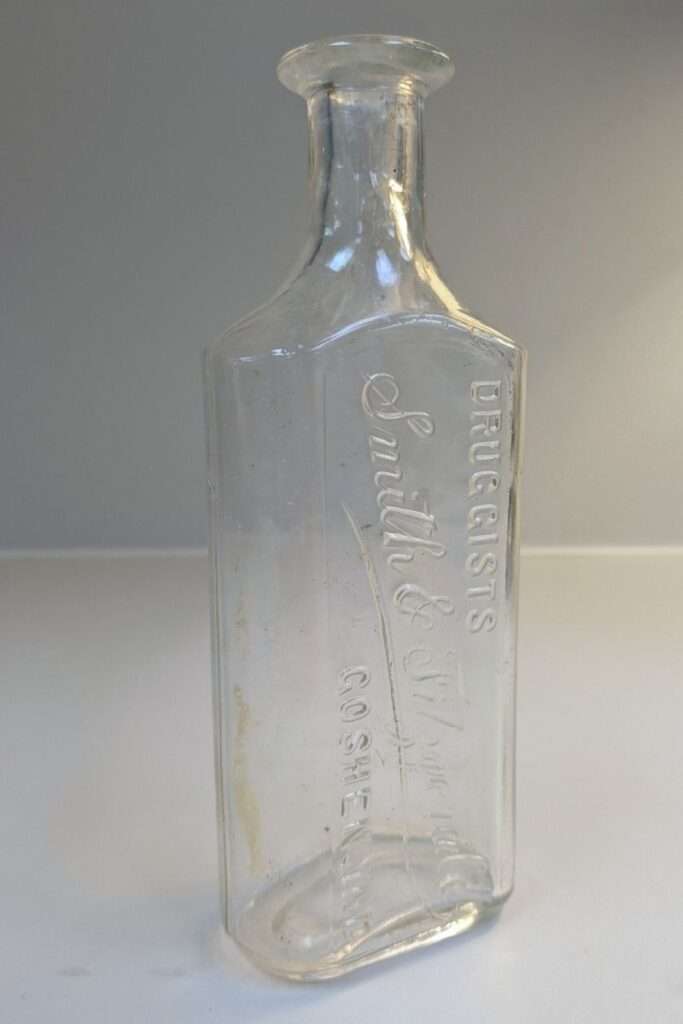
Medicine bottle, Goshen IN
Made by: Druggists Smith & Fitzgerald
Estimated Date: late 1800s
Made in: Goshen, IN
Details: 7″ tall, 2.75″ wide, 1.5″ deep
Embossing: Front: “DRUGGISTS SMITH & FITZGERALD GOSHEN, IND”
H.E. Smith and F.H. Fitzgerald owned a pharmacy in downtown Goshen, located at 135 S. Main Street. A newspaper article from The Goshen Times on November 21, 1895 read: “There are fewer lines of business better represented in Goshen than the drug trade, and among the handsomest stores on Main street, is that of Smith & Fitzgerald’s. The store is well appointed and lavishly stocked with the very best and strictly pure drugs and chemicals, fancy and toilet articles, and especial attention is paid to the prescription department.”
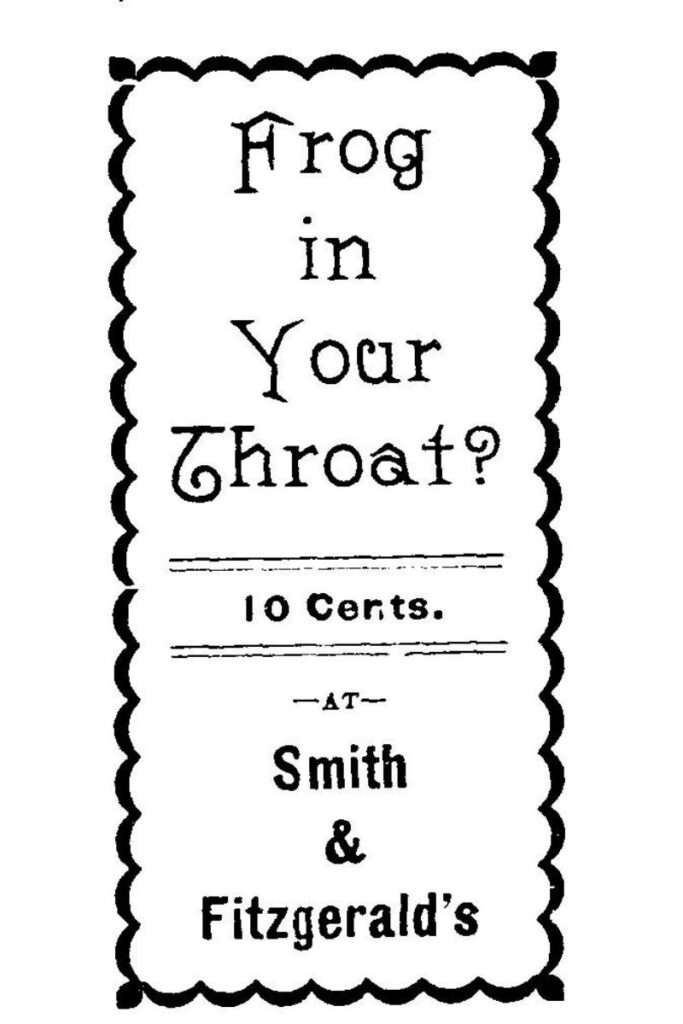
The Goshen Times, November 1895
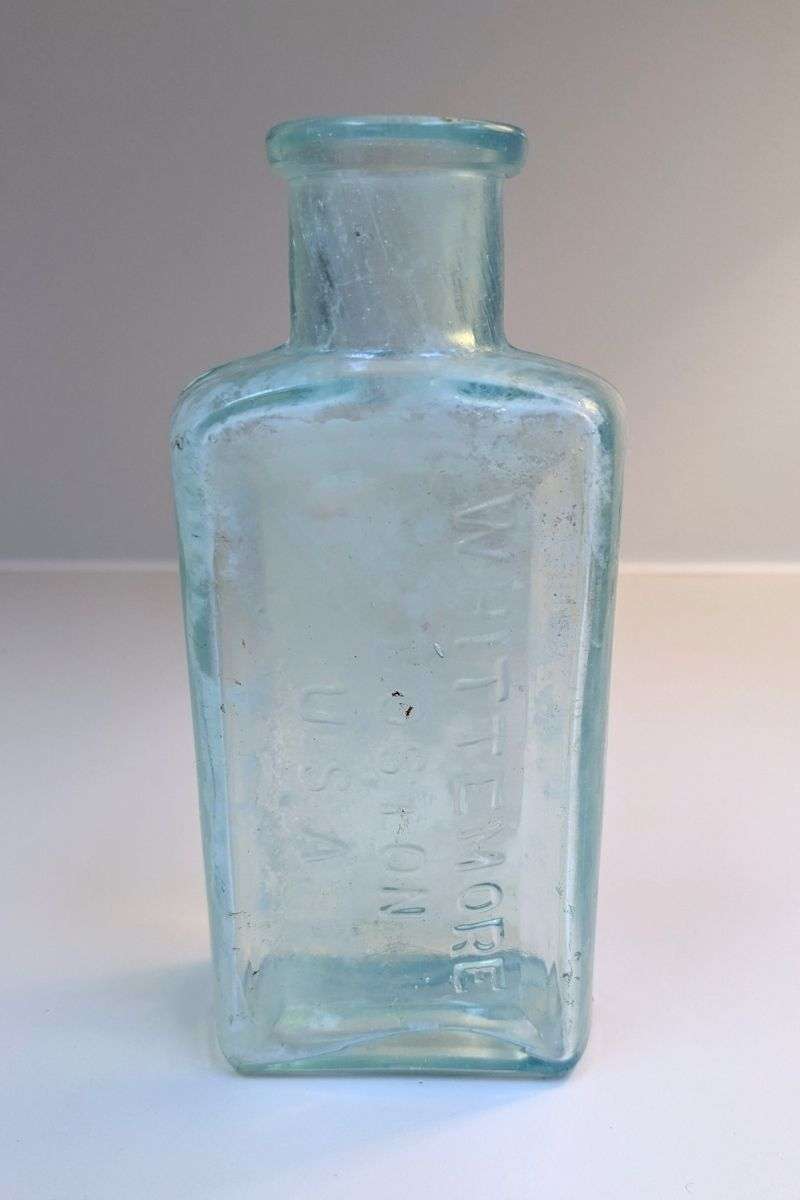
Whittemore Boston USA Shoe Polish bottle
Made by: Whittemore Brothers Corporation
Estimated Date: 1880s
Made in: Boston, MA
Details: 5.26″ tall, 2.5″ wide, 1.5″ deep
Embossing: Front: “WHITTEMORE BOSTON U.S.A”
According to glassbottlemarks.com, most glass bottles marked “Whittemore, Boston USA” contained shoe polish, also known as “shoe dressing.” Advertisements say that the Whittemore Brothers Corporation were “Manufacturers of Shoe Polishes, Dressing, Dyes”
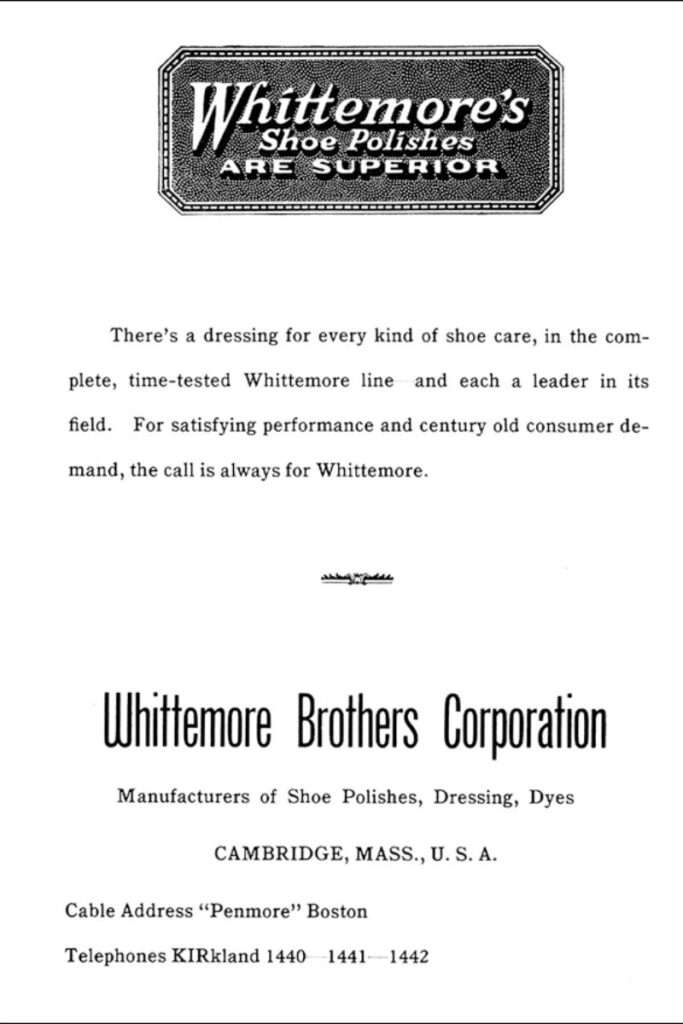
“There’s a dressing for every kind of shoe care, in the complete, time-tested Whittemore line and each a leader in its field. For satisfying performance and century old consumer demand, the call is always for Whittemore.”
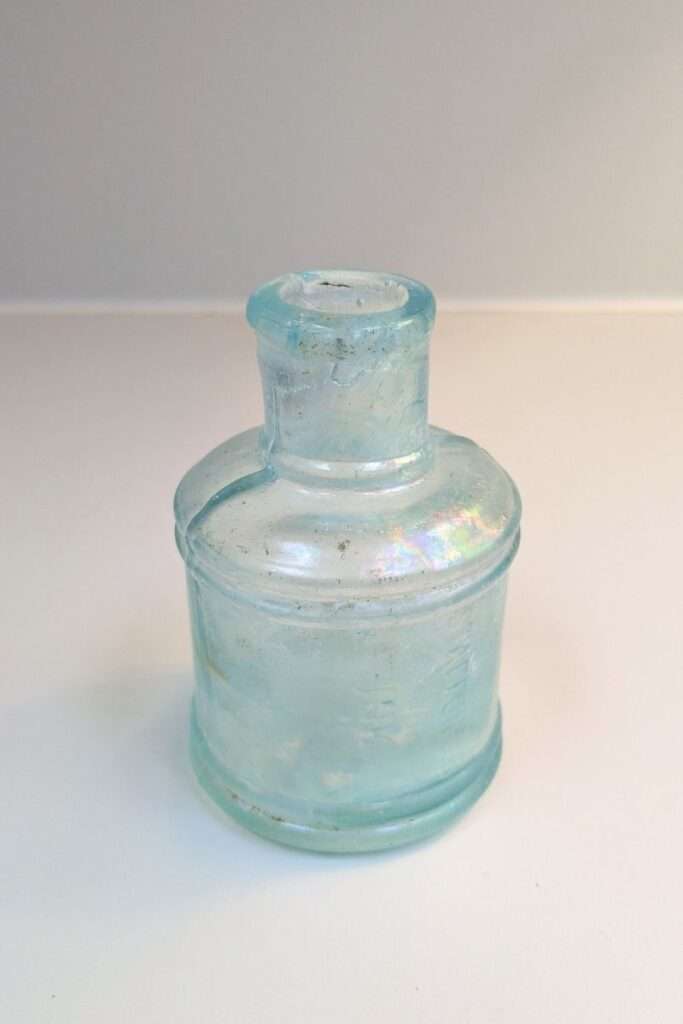
Staffords Ink bottle
Made by: S. S. Stafford, Inc
Estimated Date: 1858-1920
Made in: New York City
Details: 3″ tall, 2″ wide, teal glass
Embossing: Side: “STAFFORD’S INK”
According to a blog called Bay Bottles, “Primarily known as an ink manufacturer, S. S. Stafford, Inc. was founded by Samuel Spencer Stafford. His February 16, 1895 obituary in the New York Times mentioned his early years as well as his entrance into the ink business sometime in 1858.”
Stafford’s sold items such as “Stafford’s Combined Writing and Copying Fluid,” “Stafford’s Perfumed Violet Ink,” and also an adhesive called “Stickwell & Co’s Mucilage” and a leather preservative called “Caouthoucin.” Throughout the 1920s they continued to expand their products, including many inks, stamp pads, typewriter ribbons, furniture polish, and more.
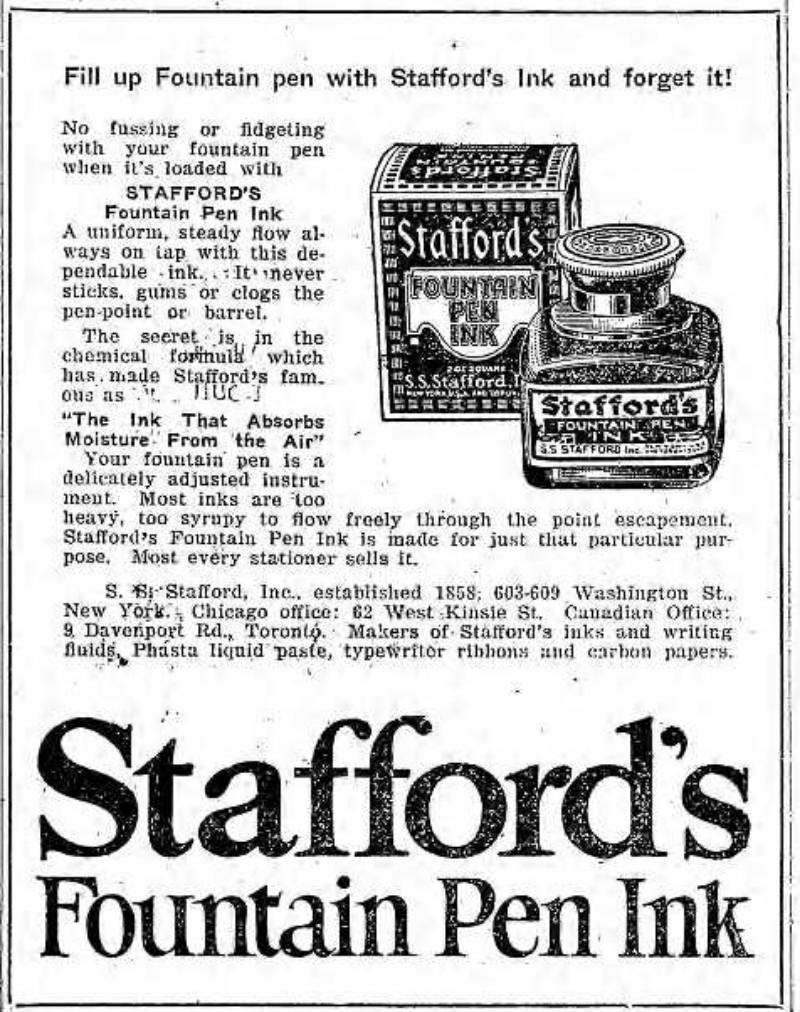
“No fussing or fidgeting with your fountain pen when it’s loaded with STAFFORD’S Fountain Pen Ink. A uniform, steady flow always on tap with this dependable ink. It never sticks, gums, or clogs the pen-point or barrel.
The secret is in the chemical formula which has made Stafford’s famous as [___].
‘The Ink That Absorbs Moisture From The Air’“
Advertisement in the November 23, 1920 issue of the Chicago Daily, Illinois
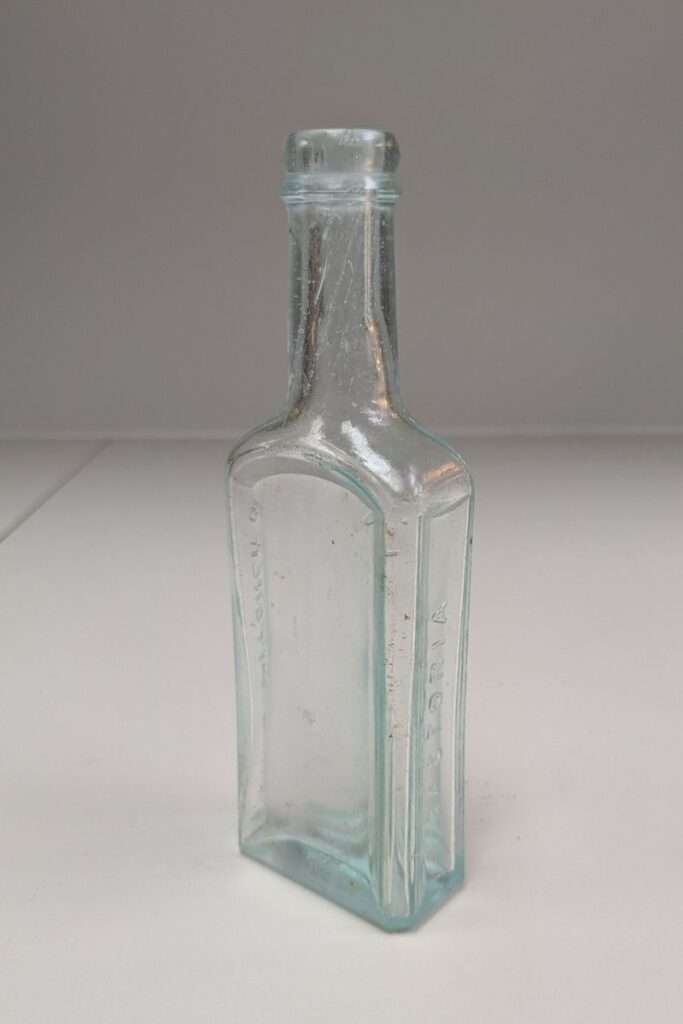
Dr. S Pitcher’s Castoria bottle
Made by: Samuel Pitcher, Pitcher’s Castoria Mrg. Co
Estimated Date: 1868-1897
Made in: Boston, MA
Details: 5.75″ tall, 1.75″ wide, 1″ deep
Embossing: Sides: “DR. S PITCHER’S / CASTORIA”
The patent in 1868 for this children’s medication described a formula made of “senna leaves, bicarbonate of soda, essence of wintergreen, extract of taraxacum, sugar, and water. The mix likely also included pumpkin, anise and worm seed, Rochelle salts, peppermint, and 3 percent alcohol.
Lockhart, Bill, et al. Pitcher’s and Fletcher’s Castoria an Uncommon Study of Common Bottles.
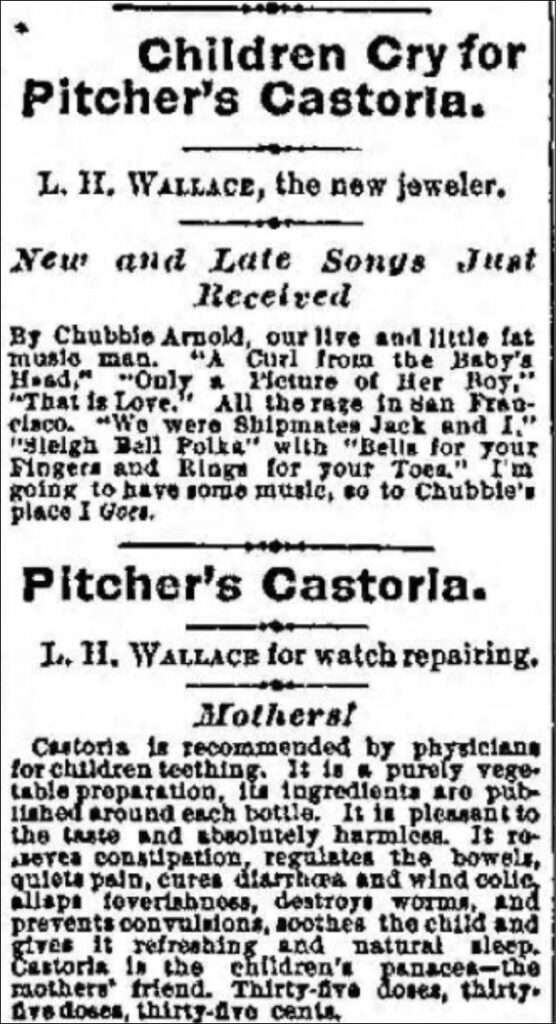
“Castoria is recommended by physicians for children teething. It is a purely vegetable preparation, its ingredients are published around each bottle. It is pleasant to the taste and absolutely harmless. It relives constipation, regulates the bowels, quiets pain, cures diarrhea and wind colic, [..] feverishness, destroys worms, and prevents convulsions, sooths the child and gives it a refreshing and natural sleep. Castoria is the children’s panacea–the mother’s friend. Thirty-five doses, thirty-five doses, thirty-five cents.”
Ogden Standard, Newspaper Archives, August 17, 1890 Page 3
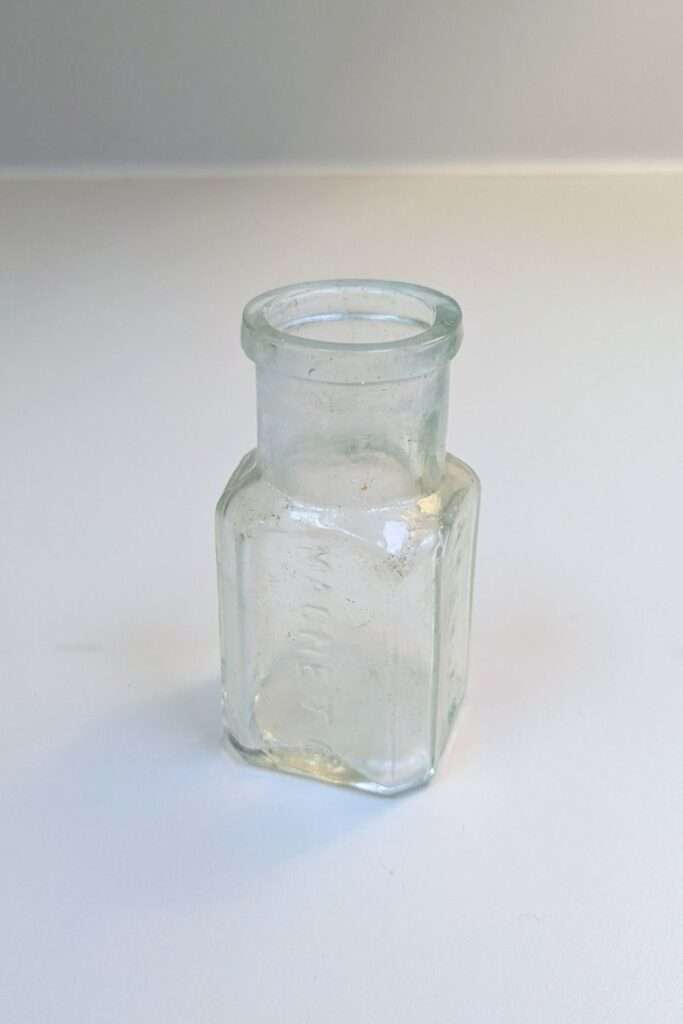
A. Trasks Magnetic Ointment
Made by: D. Ransom, Son & Co
Estimated Date: 1846-1900s
Made in: Buffalo, NY or Fort Erie, Canada
Details: 2.5″ tall, 1.5″ square body
Embossing: Sides: “A. TRASKS / MAGNETIC / OINTMENT”
Quote from centerforinquiry.org: ““Various ‘magnetic’ balms, oils, and other products were common in America, especially during the nineteenth century and before the passage of the Pure Food and Drug Act of 1906 (effective January 1907). Usage of the word stemmed from the generalized meaning of ‘magnetick’ which meant ‘having powers correspondent to those of the magnet, attractive.’ Magnetic became a pseudoscientific buzz-word. “
Nickell, Joe. ““Magnetic” Medicines.” Centerforinquiry.org, Center for Inquiry, 12 Oct. 2016, centerforinquiry.org/blog/magnetic_medicines/. Accessed 2 Oct. 2025.
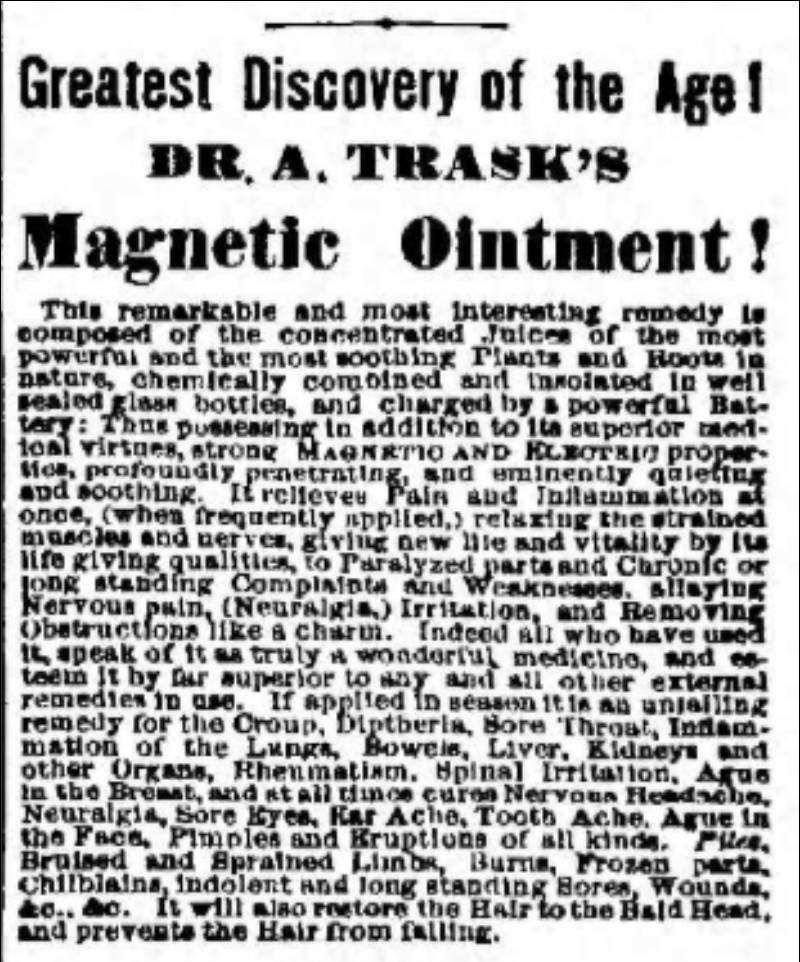
“This remarkable and most interesting remedy is composed of the concentrated juices of the most powerful and the most soothing Plants and Roots in nature, chemically combined and inoculated in well sealed glass bottles, and charged by a powerful Battery. Its great power in addition to its superior medical virtues, strong MAGNETIC and ELECTRIC properties, profoundly penetrating, and eminently active and soothing.”
St Joseph Herald Press Newspaper Archives August 14, 1869 Page 3
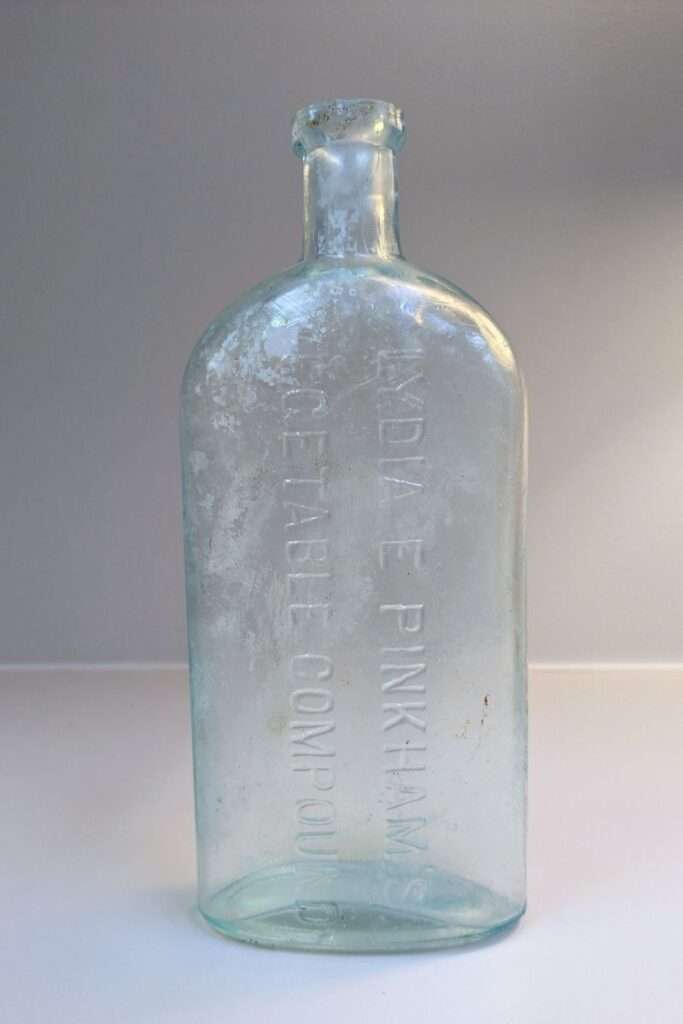
Lydia E. Pinkham’s Vegetable Compound bottle
Made by: Mrs. Lydia Pinkham Medicine Company
Estimated Date: 1876-1905
Made in: Massachussetts
Details:8.5″ tall, 33.625″ wide, 1.75″ deep
Embossing: Front: “LYDIA E PINKHAM’S VEGETABLE COMPOUND”
Quote from Arizona State University’s Embyo Project Encyclopedia: ““First marketed in the US 1875, Lydia Pinkham’s Vegetable Compound was an herbal medicine used by women to relieve menstrual discomfort and menopausal symptoms. The herbal compound was invented by Lydia Estes Pinkham in 1873 in her home kitchen in Lynn, Massachusetts. Pinkham created the compound by mixing alcohol with roots and herbs. The compound was patented, packaged, and distributed by the Mrs. Lydia Pinkham Medicine Company in 1876. The Mrs. Lydia Pinkham Medicine Company advertised the compound in many US newspapers and magazines, causing Lydia Pinkham’s Vegetable Compound to become a household name and making treatments for female reproductive discomfort mainstream in the US.”
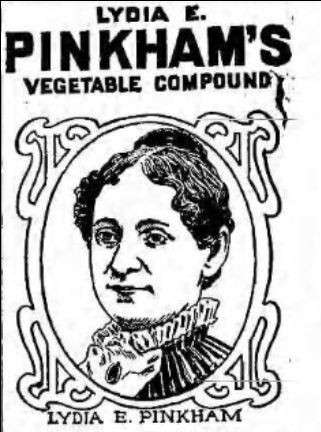
“No other medicine for Woman’s ills in the world has received such wide-spread and unqualified endorsement as has Lydia E. Pinkham’s Vegetable Compound, made from native roots and herbs.
No other medicine has had such a record of success for women’s diseases, or such hosts of grateful friends, as has Lydia E. Pinkham’s Vegetable Compound.
For more than 30 years it has been the standard remedy for feminine ills, Inflammation, Ulceration, and consequent Spinal Weakness.”
Elkhart Daily Review Newspaper Archives July 21, 1908 Page 6
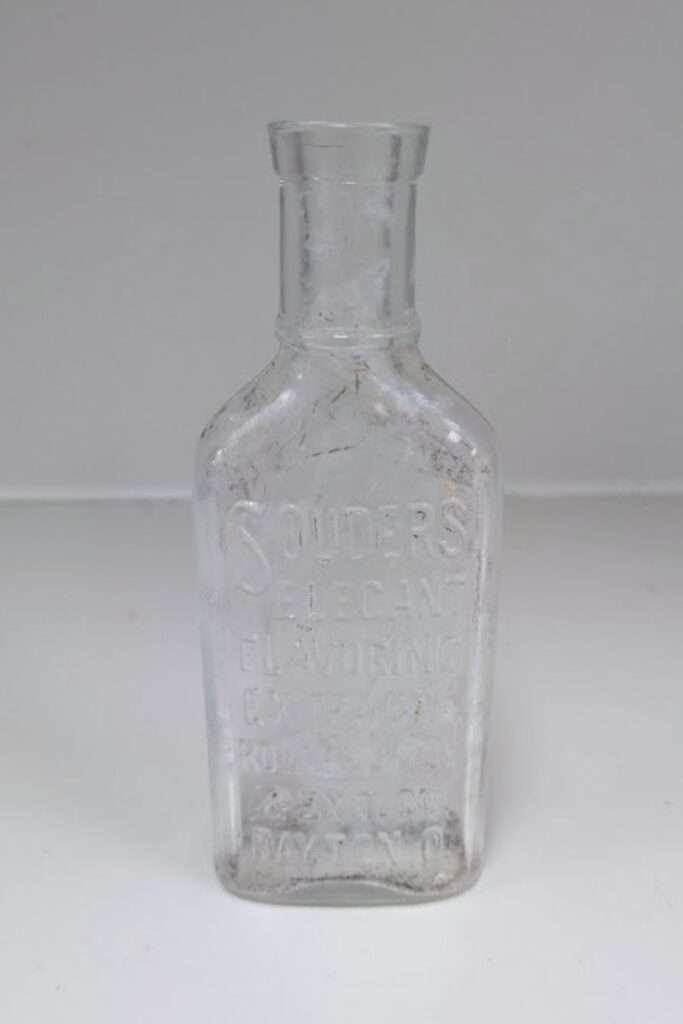
Souders Elegant Flavoring Extracts bottle
Made by: Souders Royal Remedy & Extract Company
Estimated Date: 1880-1900
Made in: Dayton, OH
Details: 5″ tall, 2″ wide, .75″ deep
Embossing: Front: “SOUDERS ELEGANT FLAVORING EXTRACTS ROYAL REMEDY & EXT. CO DAYTON, O”
Souders Royal Remedy & Extract Company manufactured flavoring extracts, perfumes, and special remedies.
From Business & Advertisements of Dayton Circa 1889:
“They make extracts of lemon, vanilla, tropic fruit flavor, orange, Jamaica ginger, rose, almond, strawberry, raspberry, banana, essences of cinnamon and wintergreen. In odors they make all the popular ones, including Frangipanni, Patchouly, Opoponax, White Rose, Jockey Club, Heliotrope, Ylang Ylang, Rose Geranium and others. They also make a particularly high grade of Cologne. A recent specialty of the house is the manufacture of refined chewing gum, which, under the brand title of “Sweet Wheat”, is being rapidly adopted by the trade as a standard of excellence and purity.”
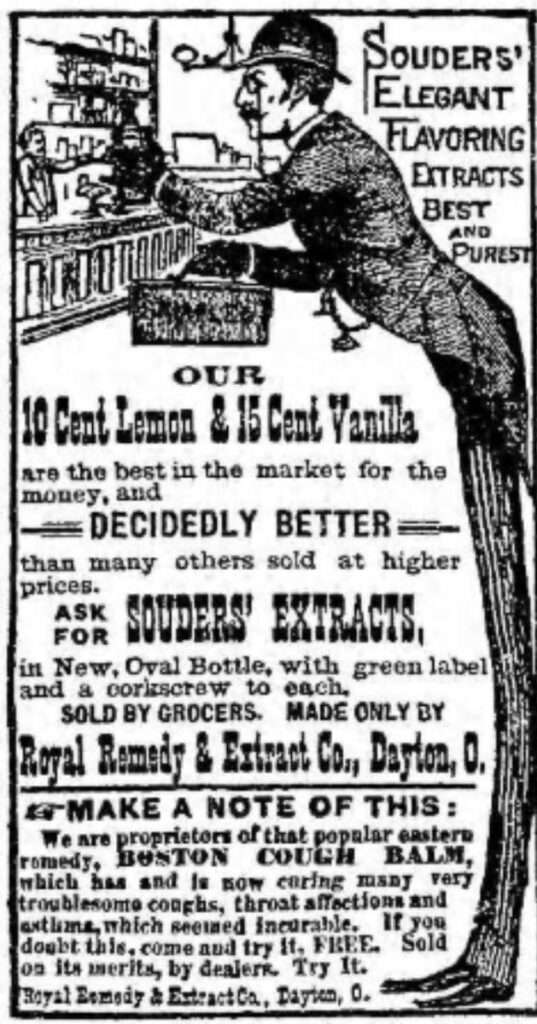
“Souders’ Elegant Flavoring Extracts Best and Purest
Our 10 Cent Lemon & 15 Cent Vanilla are the best in the market for the money, and decidedly better than many others sold at higher prices. Ask for Souders’ Extracts, in New, Oval Bottle, with green label and a corkscrew to each. Sold by grocers. Made only by Royal Remedy & Extract Co., Dayton, O.”
Middlebury Independent Newspaper Archives July 18, 1889 Page 1
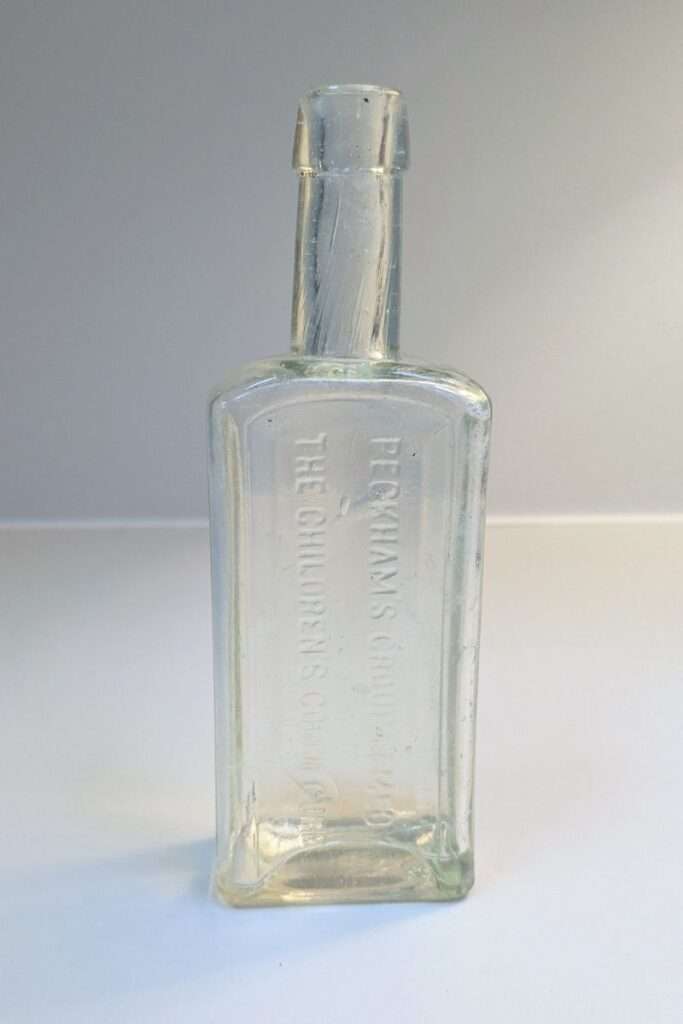
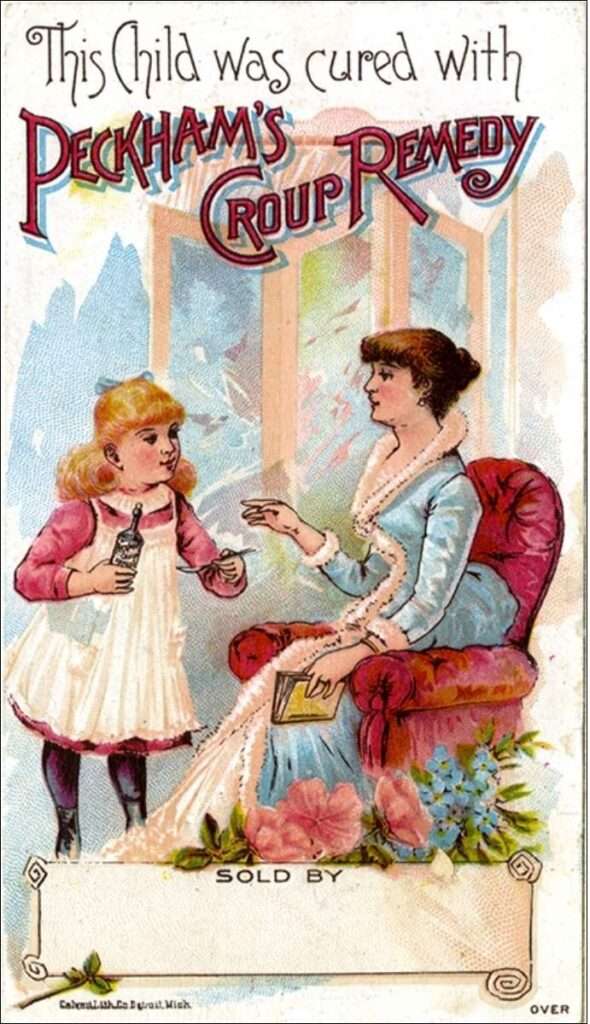
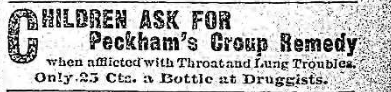
Peckham’s Croup Remedy bottle
Made by: Peckham Remedy Co
Estimated Date: 1875-1990s
Made in: Freeport, Michigan
Details: 6″ tall, 2″ wide, 1.1875″ deep
Embossing: Front: “PECKHAM’S CROUP REMEDY THE CHILDREN’S COUGH CURE”
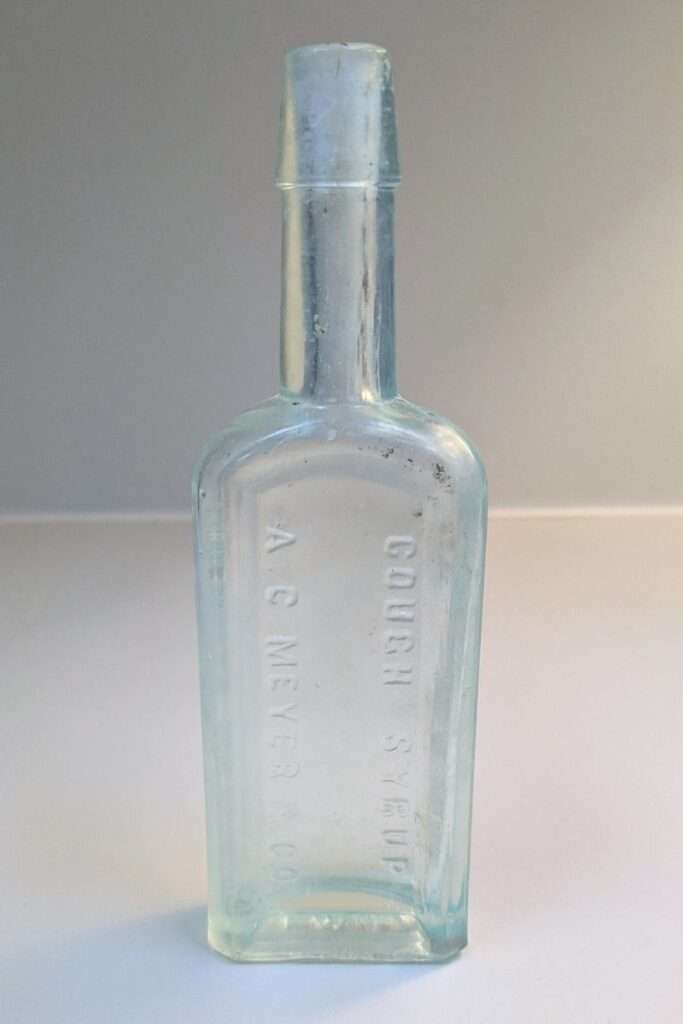
Dr. Bull’s Cough Syrup bottle
Made by: A.C. Meyer & Co
Estimated Date: 1870-1900
Made in: Baltimore, Maryland
Details: 6″ tall, 1.875″ wide, .875″ deep
Embossing: Front: “DR. J. W. BULL’S / COUGH SYRUP / A.C. MEYER & CO / BALTIMORE, MD, U.S.A.”
From peachridgeglass.com: “In 1855 or so, in Baltimore, Maryland, Dr. John W. Bull began the manufacture and sale of a cough remedy known as “Dr. Bull’s Cough Syrup,” which was put up in packages of a characteristic form and appearance. Dr. Bull was first listed as a druggist and was in business until the early 1870s when he sold the rights to his patent medicines to August Vogeler and Adolph C. Meyer eventually of A. C. Meyer & Co.”
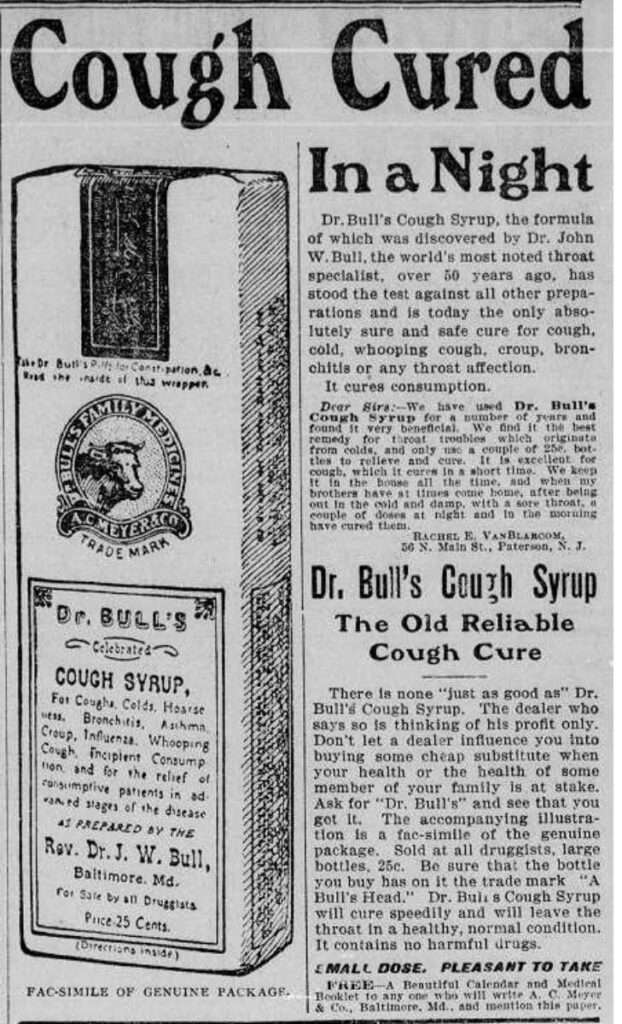
“Many people are invalids as regards their lungs. Upon the slightest exposure to draughts and cold air, they have pains in the chest, sore lungs, cold, cough and other symptoms bordering on pneumonia. For such sufferers DR. BULL’S COUGH SYRUP is unquestionably the best remedy, curing the various ailments mentioned, and staying the progress of an insidious throat and lung affection where the patient is predisposed to such on account of weak lungs.”
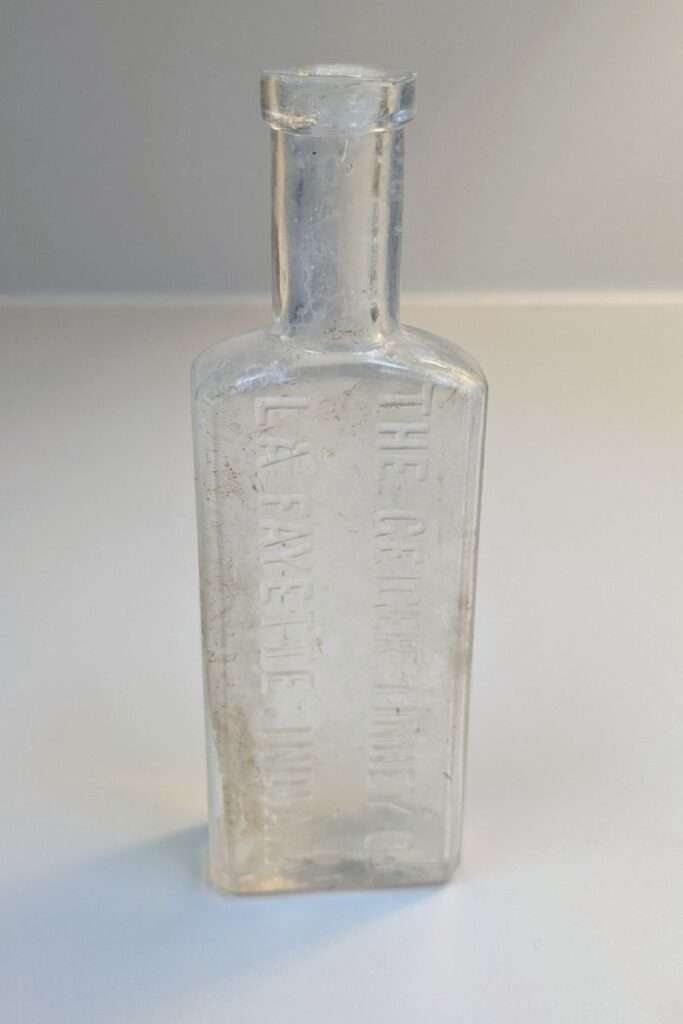
Geiger-Tinney Co. bottle
Made by: Geiger-Tinney Co
Estimated Date: 1892-1901
Made in: Lafayette, Indiana
Details: 4.5″ tall, 1.5″ wide, .75″ deep
Embossing: Front: “THE GEIGER-TINNEY CO LA FAYETTE, INDIANA”
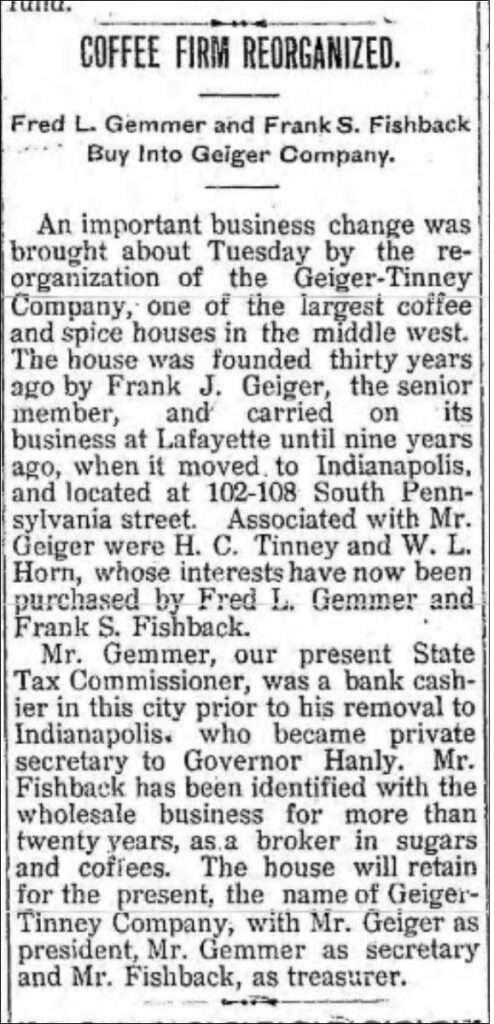
The coffee, tea, and spice company that became Geiger-Tinney Co was founded under the name “Culver & Geiger” in Lafayette by Frank J. Geiger. He died in 1889, then in 1892 the Geiger-Tinney company was formed with F.J. Geiger as president. The company moved to Indianapolis in 1901, so this bottle must have been produced between 1892-1901, when they were still in Lafayette.
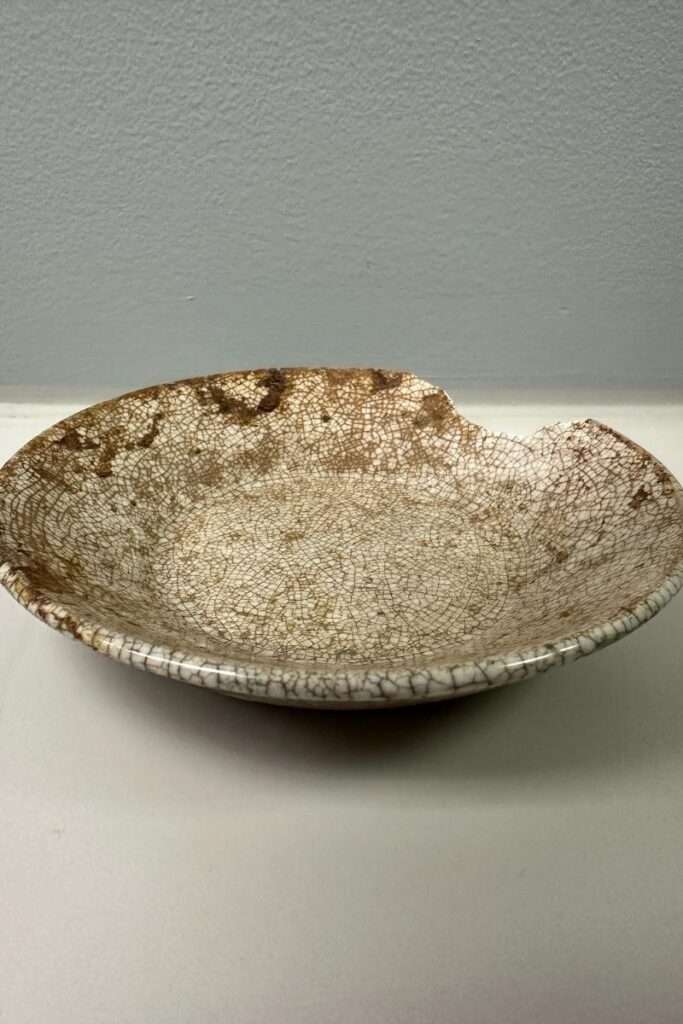
Small dish, china
Made by: John Edwards (later John Edwards & Co.)
Estimated Date: 1860-1890
Made in: Staffordshire, England
Details: 4.81″ diameter, 1″ tall
Maker’s Mark: “WARRANTED IRONSTONE CHINA / TRADE MARK / JOHN EDWARDS” (Image: Prince of Wales Feathers)
This ironstone dish was made by John Edwards in Staffordshire, England between 1860 and 1890. The maker’s mark features the Prince of Wales feathers and the phrase “Warranted Ironstone China,” indicating it was a British-made-for-export piece from the Victorian era, marketed for foreign buyers (especially in the U.S.). Pieces like this were common in Midwest households as both everyday dishes and used for more formal table settings.
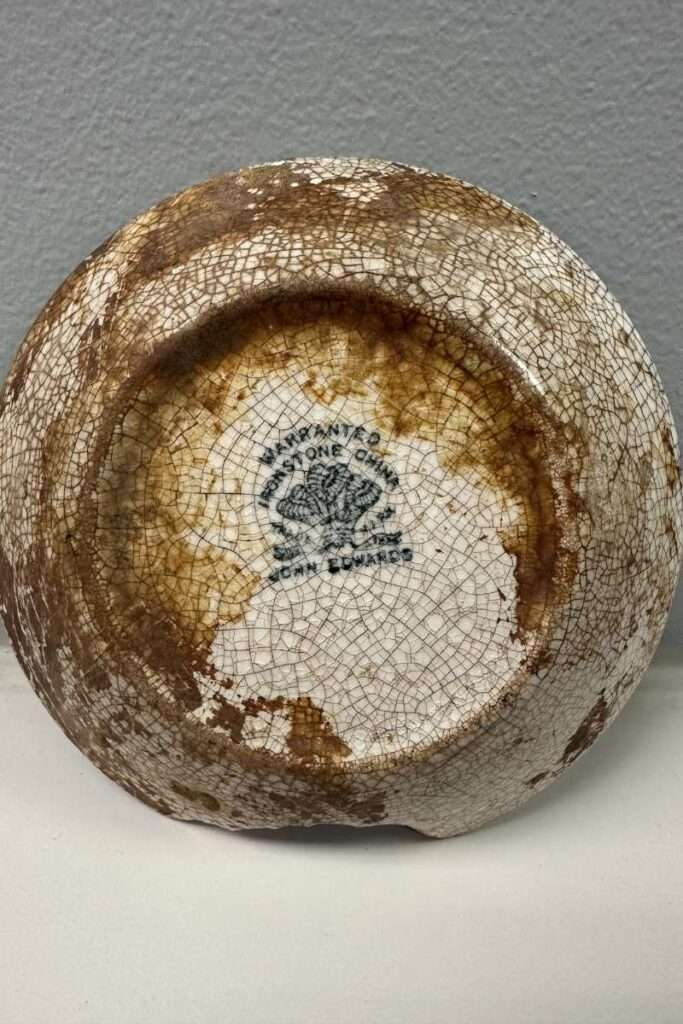
Maker’s Mark:
WARRANTED IRONSTONE CHINA
TRADE MARK
JOHN EDWARDS
image: Prince of Wales feathers